
Breaking ground
There’s an old story about Calvin Coolidge, a Vermonter and the 30th President, known as “Silent Cal.” A woman is sitting next to him at a state dinner. “My husband bet me I couldn’t get you to say more than two words to me all night,” she says to the President. Coolidge’s response: “You lose.”
We haven’t been writing much because there hasn’t been much to write about. Some paper shuffling, a slight re-orientation of the house, filing various documents with the county, a drainage plan, a few phone calls. All insubstantial.
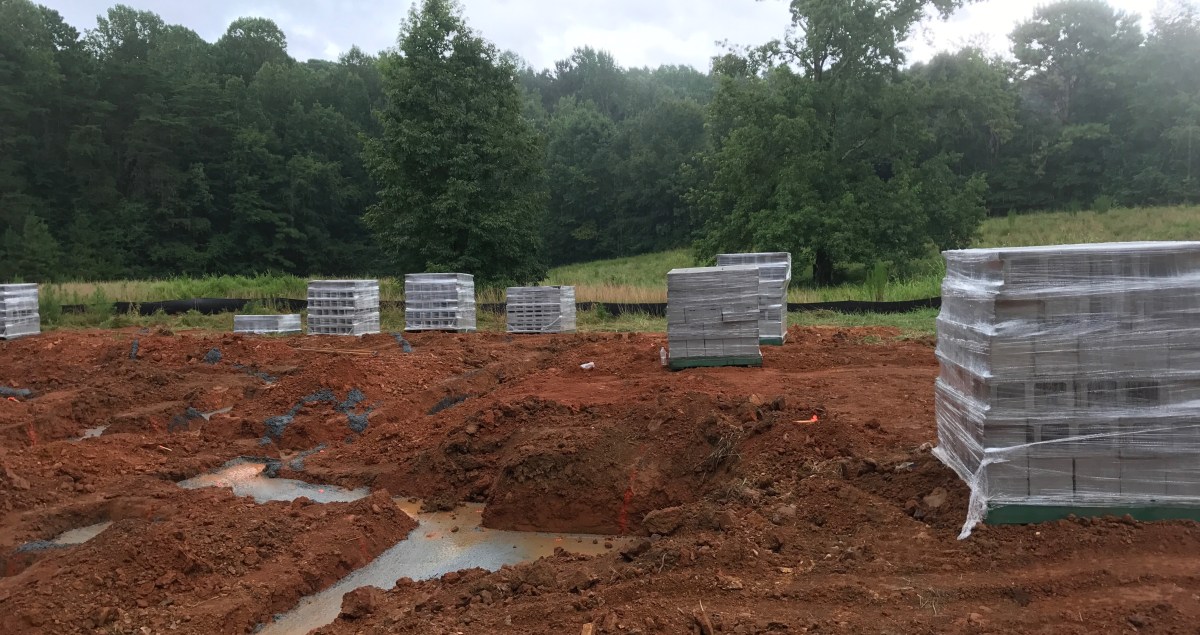
But all of a sudden, things are happening. There’re trucks, bulldozers, and pallets of concrete blocks. Surveying equipment. Holes in the ground. Footings being poured. Bricks on the way. Nearly two years into this project, we’ve broken ground. In a week or so the foundation will be in, weather permitting. Three or four weeks after that, the framing will be done.
Now comes a series of decisions. First up: HVAC. Nora has been doing the research and, as a result, we’re going with geothermal. Geothermal takes advantage of the temperature of the ground — which stays pretty constant four or five feet down — to lower the energy needed to heat and cool the house. It’s more expensive than a traditional system, but also more efficient, and pays back in about ten years. (Idea for a Baby Boomer business: a combo savings calculator/actuarial table.)
We’ll most likely go with a vertical, closed-loop system in which you drill a few holes anywhere from 50 to a couple of hundred feet deep, line them with pipe, then pump a fluid through the circuit. Heat is exchanged with the fluid moving through the loop, which stays at a more or less constant temperature (unlike the air). Savings equate roughly to the difference between the ambient temperature and that of the ground.
Next up, everything from the window screens to the color of the brick mortar — do we need white sand? We found some very cool holophane industrial lights up in the Hudson River Valley for over the kitchen island. They need to be cleaned up and re-wired (it helps to have a brother who’s an electrician), but they’ll add some historical interest. Straight from a 1950s factory somewhere in the Midwest. Making illumination great again.
There’s another well-known Coolidge story. He’s coming back to the White House from church one Sunday. His wife asks, “What was the sermon about?”
“Sin,” says Cal.
“What did the minister say about it?” she inquires.
“He was against it.”
And so it goes. (Apologies to our youngest daughter, who recently discovered Kurt Vonnegut.)
 500 miles