
Tobacco Barns
There’s nothing quite so unnerving as seeing a six foot black snake drop down from the top of a tobacco barn right after you’ve just finished hanging a morning’s worth of leaves — hauled in from the fields, stitched across the stakes, and lifted into place across half a dozen rows of tiered beams. This wasn’t all that unusual as I found out later. The barns sit empty in the winter, the mice and other rodents make their way in, and the snakes follow. The first time the flues are lit to cure the tobacco the heat drives all of them out and back into the fields. But before you turn it on you have to hang the leaves, otherwise you’re just wasting gas.
A lot of us had those kinds of jobs back then. Things our parents sent us out to do to earn money in the summer and “build character.” They were in construction, mostly, and sometimes factory work. A glass manufacturing plant was popular where I lived in my mid-teens — it was high dollar labor, if you could stand the heat of the furnaces. If your father was a lawyer, maybe you went to his office and shuffled papers.
My family had been associated with tobacco one way or another for generations, so my Dad volunteered me for the farm. Day laborers came and went during that summer but the three regulars with me were George, Willie, and Calvin. Calvin drove the tractor. George, Willie, and I humped leaves, picked rocks out of the fields, and hauled irrigation pipe.
At lunch time, we sat in the shade and ate Vienna sausages (pronounced Vy-Anna) out of the can and tinned meat on saltine crackers. Willie was wall-eyed and a demon worker; George was lanky and quiet, with a wife and young son. After a ten-hour day priming tobacco he would go home, eat, then head to town to work the night shift at the local cotton mill. How he stood that, I don’t know.
Come mid-summer, a big man could disappear in the rows of tobacco plants, and you could find snakes there, too, sleeping in the shade. What there wasn’t was much of a breeze. It was hot and deadly humid, and you had to wear a long sleeve shirt to keep the tobacco gum from eating you up. By the middle of August we would have gone up and down those rows half a dozen times, pulling “suckers”, pulling leaves. At the end of the day we would head back to the farm, bumping along the dirt roads on a flatbed behind the tractor, followed by a cloud of red dust.
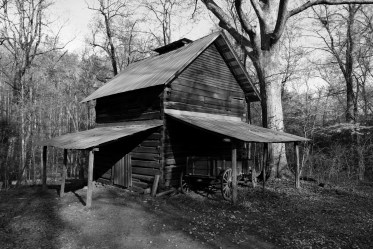
There were once 500,000 tobacco barns in North Carolina, according to a story in Our State Magazine (Tobacco barns in North Carolina). Simple, utilitarian, and if you ever stood beneath the tin roof of one in a summer thunderstorm, you know you could hear Jordan roll right then and there. Now, maybe just one in ten are still standing. To see them falling over by the roadside, it’s like the ghost of Joseph Califano is marauding through the state one last time, ripping them apart board by board.
But history isn’t so easily discarded, and those of us who grew up in Durham and are of a certain age know that our lives will always be linked to bright leaf tobacco. We know the sweet smell rising from the downtown warehouses, and we saw the mostly positive knock on effects of the funding of Trinity College by the Dukes and their tobacco trust — the history professor who taught Sunday school or the father of a classmate with doctorate in physics who dropped by an elementary school class to demonstrate the principles of refrigeration or, on the lighter side, scoring a vanilla Coke from the “Dope Shop” in the basement of the old student union and summers spent tossing frisbee in Duke Gardens. Much of this on tobacco’s dime.
It goes to show you how complicated the past can be. And, as it turns out, tobacco barns, like tobacco money, can be re-purposed (Something old, something new). Nora’s thinking garage – snake free.
Something to keep in mind in these Manichean times.
 500 miles